

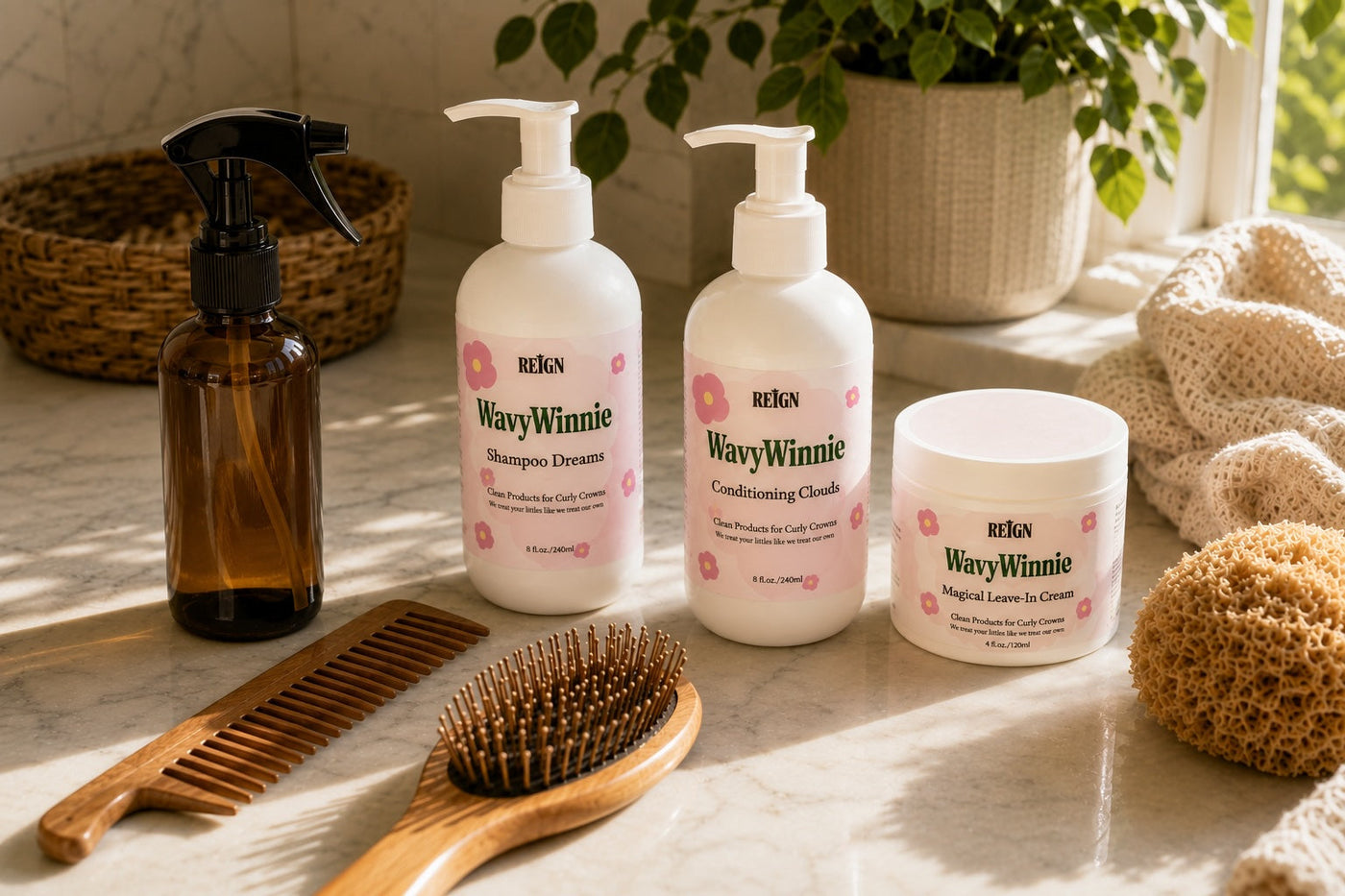
If you have read Find Your Curl Type and Understanding Porosity, you already have the two pieces of information that make wash day make sense. Now let us put them to work.
I want to say something first, because I think it matters more than any step in this routine. Wash day does not have to be a battle. In twenty five years, so many parents have shared the same story with me, tears, tangled combs, a child bracing before the water even runs. It does not have to be that way, and it was never supposed to be that way. Wash day can be one of the most connected hours you spend with your child all week, if the routine works with their hair instead of against it.

Before you start
Know your child's curl type, roughly, from our earlier guide. Know their porosity, low, high, or somewhere in the middle. You do not need to be precise. You just need a general sense, because it changes two things below, how much product you use and how you layer it.
Gather everything before you start. A detangling brush, a gentle sulfate free shampoo, a conditioner, a leave in, and if your child runs high porosity or a tighter curl pattern, a sealing oil. Having everything within reach means you are not leaving a wet, detangled head of curls to go dig through a cabinet.
Step one, detangle first
Detangle before you wash, not after, whenever you can manage it. Curls tangle more easily once they are wet and full of product, so starting with dry or lightly dampened hair and working through knots with a detangling brush, gently, from the ends up toward the roots, saves you some time later and gives the hair a little extra love before it ever hits water. Some conditioner or a detangling spray on dry hair beforehand makes this easier still. A pre poo treatment works well here too, and can give hair an extra hydration boost while it helps the detangling process along.
Go slowly here. This step sets the emotional tone for the whole routine. A rushed detangling session is where most wash day tears start.

Step two, cleanse
Wet hair thoroughly and cleanse with a gentle, sulfate free shampoo, something like our Shampoo Dreams, which works across every curl type and porosity level, making it a safe place to start no matter what you learned in the last two guides. Focus the shampoo mostly at the scalp, where oil and product actually build up, and let the lather rinse through the lengths rather than scrubbing the ends directly, since curls are more fragile toward the tips.
How often you do this depends on your child's hair. Once a week works well for many curl types. Thicker, drier, or higher porosity hair sometimes prefers every ten days to two weeks, since more frequent washing can pull needed moisture out faster than it can be replaced. There is no single right answer here, only what your child's specific hair asks for over a few tries.
Step three, condition
Apply conditioner generously through the lengths, again focusing less on the scalp. Our Conditioning Clouds works beautifully as a lightweight option for Type 2 and lighter Type 3 curls. For thicker or Type 4 textures, pair it with a deeper, more intensive treatment, since that hair generally asks for more moisture and more time to absorb it.
This is a good moment to finish any detangling you did not fully complete in step one, since conditioner gives your detangling brush some slip to work with.

Step four, leave in and seal
This step is where curl type and porosity actually change the routine. Apply our Magical Leave-In Cream while hair is still soaking wet, straight out of the shower, if you are using it as your styler, this is what helps it distribute evenly and lock in definition. It is our two in one moisturizer and curl definer, and the product most curl routines are built around. For Type 2 and Type 3 curls, this often does the whole job on its own.
For Type 4 curls, or for any texture running higher porosity, layer an additional leave in beneath it and follow with a sealing oil on top, to give that moisture something to hold onto before it has a chance to escape, the same layering logic covered in Understanding Porosity.
If your child runs low porosity, use a lighter hand here. Product tends to sit on the surface of that hair rather than absorb quickly, so more is rarely better, it is more often just heavier.
Step five, style, simply
You do not need a diffuser, a special brush, or a complicated technique to get beautiful curls. A gentle scrunch upward with cupped hands, working in sections, encourages the natural curl pattern to clump and define. Once product is fully applied, plop the hair into a tshirt material towel. This helps the curls clump together beautifully, and it is the right move if your child will be wearing their hair down that day. One note worth remembering, never pineapple the hair while it is still wet. Wet curls have not set into their pattern yet, and gathering them at the crown before they dry can misform the curl.
Let hair air dry whenever your schedule allows it. It is gentler on the hair, and there is no rush here worth trading for it.

A note on timing and patience
None of this needs to happen quickly. A full wash day for curly hair, especially thicker or longer hair, can reasonably take thirty minutes to an hour once you include detangling and drying time. That is not a sign you are doing something wrong. That is simply what curly hair, cared for well, actually takes.
Making wash day something your child looks forward to
A few small things change wash day from a chore into a ritual. Play music your child loves. Let them hold the bottles and help pour, even if it is messier that way. Narrate what you are doing gently, this is going to help your curls stay soft, rather than silently working through knots with a tense jaw. Children absorb the emotional tone of a routine as much as the routine itself.
The way you talk about your child's hair during this hour becomes part of how they learn to feel about themselves. Wash day is not just a maintenance task. It is one of the most repeated, physically close rituals you share with your child, and it is a real opportunity to say, without ever needing the words directly, that their curls, exactly as they grow, are already worth this care and this time.
The whole picture
Curl type tells you the shape you are working with. Porosity tells you what that shape can actually absorb and hold. This routine is where both of those pieces of knowledge finally turn into something you can do, tonight, in your own bathroom, with a child who is learning, one wash day at a time, that their crown is worth this kind of care.